Day 72: Departing Petersburg
20th July 2023
Allow me to introduce myself.
With the departure of five team members, it looks like I’ve drawn the short straw with regards to updating the blog. I can promise you all one thing, the standard of writing will drop, so bear with me. Markus has outdone himself with consistently writing every day on top of a brutal daily routine, paddling up to 20nm, carrying kit and boats over what can only be described as an assault course of a coastline: large fallen trees stacked up over soft sand or boulders and seaweed-covered rocks, mussle and oyster beds. You name it, we’ve done it. For almost 60 days, in this relentless environment, he has performed without fault. It’s a remarkable strength in him that his teammates not only thank him but, more importantly, respect and admire him for. Markus, please don’t ever stop writing! Your involvement in this project has been crucial. You have given our supporters an honest and beautiful insight into aspects of your life whilst successfully paddling up The Inside Passage. They have been blown away with this extraordinary tale. You have earned the respect you deserve. You’re an incredible bloke and we all thank you!
Day 72: Departing Petersburg
Tuesday 18th July
17 nautical miles
A bitter sweet feeling was felt by all. Marty, Cayle and I had our heads focused on squeezing the air out of dry bags, double checking equipment, trying not to forget anything – all in anticipation of the formidable task that is packing the kayaks before catching the tide out. Loading kayaks with either a full contingent of eight or only three is an unruly sight to behold. Bags everywhere; praying it doesn’t rain, blowing and slapping mosquitoes away whilst intensely scratching the existing bites in your hair, back of the neck and ears,…….why the ears man?!!!, Desperately trying to remember how we packed it last time – or the last 60 times for the matter. This usually consists of huffing and puffing, tensing and staining until finally, the hatch covers are squeezed on through gritted teeth and white knuckle determination, resulting in a genuine sense of achievement.
We said our goodbyes to the rest of the team – a hard moment for all of us. We have come so far and have created a bond over the last four and half years in training and preparation for this challenge. I honestly never thought we be in this position. It’s a cold and hard reality of prolonged adventures. Timing is crucial and the delays at the start of the trip have come back to bite us. As said by someone with far superior intelligence than I: “it’s about the journey, not the destination.” The team stepped up to this challenge, not knowing how to kayak, navigate the sea and coastline or live out of a boat. For the majority, no experience of endurance adventures. With injuries and illness that would hinder most even to dream of taking on such a demanding task. These guys have repeatedly proven, they have what it takes. From paddling South Stack and the Menai Straights in Anglesey to surf rescue training in Cornwall, to then navigating their way 1600km through British Columbia into Alaska, up the east coast of Vancouver Island, through Yuculta, Green and Dent rapids, through thick fog and rough, cold water. Taking on Dixon Entrance and Cape Fox. These areas and distances are formidable and any reasonable kayaker would question their own abilities when dreaming about taking them on.
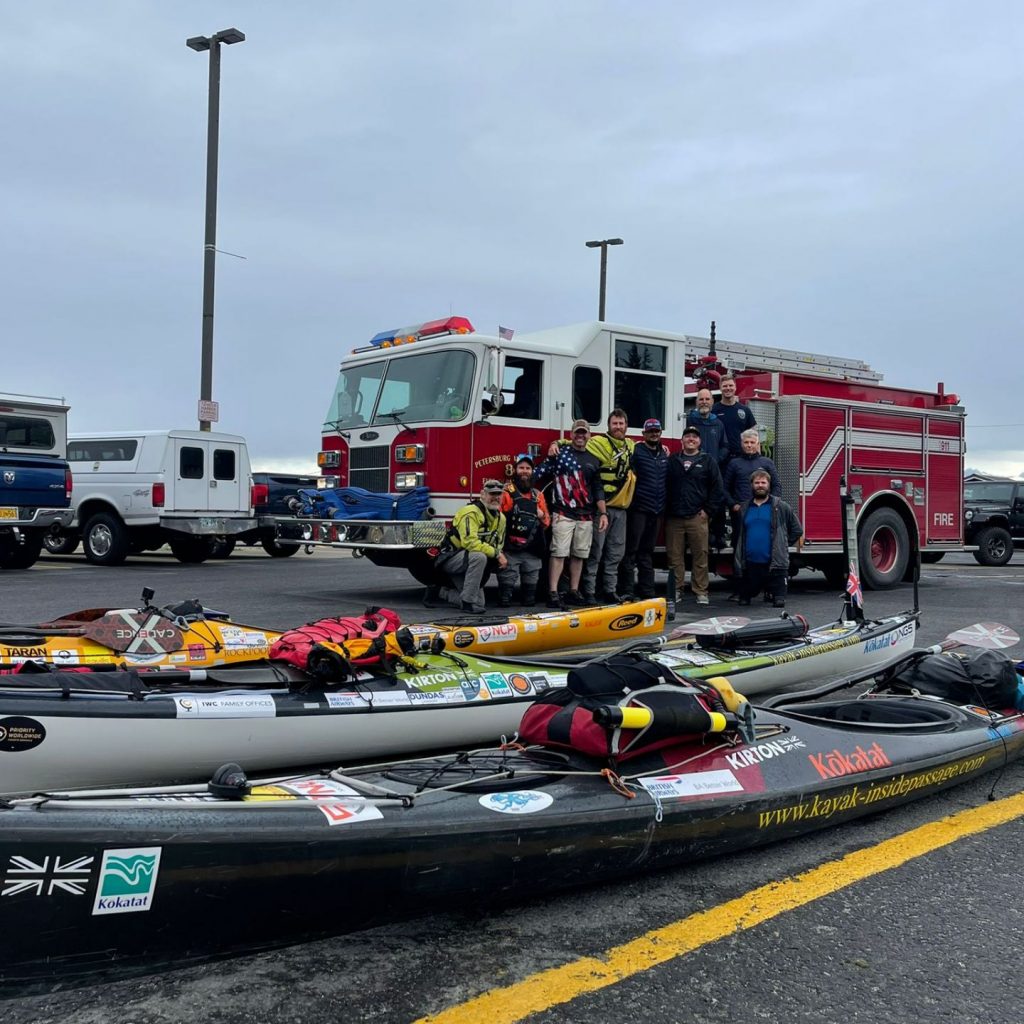
Hugs, handshakes and laughter between the team and local supporters, with a distinct air of concern for the three of us paddling on. The Petersburg volunteer fire department arrived in spectacular fashion, blue lights and sirens filled the small town as we squeezed air from our dry suits, snapped spray deck onto cockpits and deployed rudders. A raised paddle to the boys as we turned the first corner, out of sight.
Thank you again to all the truly wonderful people of Petersburg. The Fire department, the US Coastguard. Jonesy, we owe you big time mate!

The three musketeers – the first two miles were slow against the current as we went through the Petersburg narrows. This wasn’t a surprise I hasten to add. To catch the back eddies further up the coast, we simply have to weigh up our progress against the force of the current when the tide is working against us. A sense of excitement ran through us in looking ahead to the next few weeks. Passing the fisheries that towered over us on high wooden pillars, coated in a multitude of shellfish and crustaceans, with the tide streaming past, leaving straggled but almost uniformed streaks over the surface of the clear cold water. Through local knowledge, we paddle as close as we dare to the coastline using these eddies in our favour and flew along at a remarkable 4knots. Disturbing a glorious bald eagle eating on a rock, that took flight almost immediately as we glided passed. Across the still waters of Frederick Sound, with distant rumbles of fish boats working hard, to the north stood a range of awe-inspiring mountains, coated in harsh snow and ice, with a mixture of soft white and ominous looking clouds slowing drifting through valleys. In the front and centre of this magnitude of cloud, rock and snow, sat a cold, creaking giant. Forever moving slowly down hill, consuming anything and everything in its path. This icy blue monster working its way from between the tops of two mountain peaks to the sea – the first glacier we’ve seen, truly a sight to behold. A collection of vertical explosions of white mist suddenly erupted from the water, the gentle breeze carried them away as a pod of humpbacks cruised the coast only a few hundred meters away. Marty pulled over to a beach to tweak his steering system and we continued shortly after.

The navigational plan usually changes as a result of the prevailing conditions. Every plan is created with the intention and foresight of safety. If the conditions allow, we take any presented opportunities. The south easterly light breeze and slack water allowed us to alter the plan and head due north, four miles across the Sound, aiming for the campsite. Approximately half way across there was the sound of rough moving water that slowly came into earshot. No sight of anything around, nor a wake from the distant vessels. We paddled on. With the sound increasing as we proceeded, it became clear what we were heading towards. The tidal stream moving as predicted and working in the opposite direction to the glacier and river runoff from the mountains, causing a small tide rip as the two forces of water converged. Similar to the Maranon and Negro Rivers in the Amazon basin, this partnership between dancing bodies of water adding to the dramatic and beautiful theatre we have found ourselves in: one body a cool light grey, the other a deep dark shade of green. As we proceed the sharp temperature of the water bit hard into our skin. So repeatedly having to remove our hands from the paddle shaft to stretch fingers before pushing on to land only a mile away.
A gamble we play every day comes in the form of choosing a campsite in relation to the height of tide. Ideally we want to land on high water for a short carry of boats and equipment. This might not always happen at the planned campsite as an opportunity may appear to stop short for that day and start setting up camp. Unfortunately the gamble didn’t pay off. We pushed on up the coast having looked at one potential sight. Soon after the tide started to produce a gigantic platform of soft sand and sea life that rapidly grew in front of us. Jumping out of the boats we stuck heads through bushes to quickly find a suitable campsite in the woods. Then the pure misery of unloading, carrying equipment and lifting boats to a safe position at the top of the beach begins. Having had a 6-man strong lifting team to carry six kayaks, Marty and I are now taking on this job. We have half the amount of kayaks to lift but only a third of the original lifting team. If we weren’t sweating before starting the 300m walk up the beach, we definitely were by the end. One boat done, two to go, and so on.
Fire off a bear-banger, tarps and then tents erected. Get out of the drysuit in double time, clean yourself, get into warm clothes and coffees on. Revel in the fact the tent is dry and we are warm; we have food and water and the fire on the beach is lit to dry out the soggy thermals. Tidal height, times and currents, along with the weather forecast are all studied to decide our departure time for the following day. Pack food away from any potential inquisitive bears or raccoons. Mosquito spray and nets on.
The day is done.